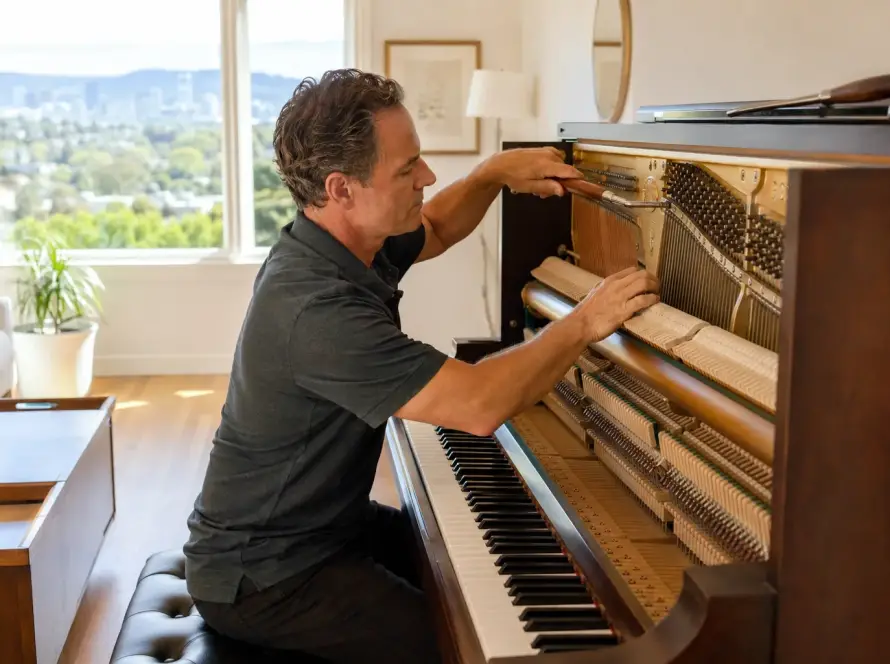
Most piano owners book a tuning appointment without really knowing what to expect. How long will the technician be there? Will it take longer if the piano has not been touched in a few years? Does it matter how often you play?
These are fair questions, and the answers affect how you plan for the appointment and how you think about ongoing maintenance.
The Short Answer: 1 to 2 Hours for Most Pianos
A piano tuning appointment typically runs between one and two hours. A well-maintained instrument that gets tuned regularly can be done closer to the one-hour mark. A piano that has not been tuned in several years, or one that has drifted significantly from standard pitch, will take longer.
Plan for two hours to be safe. That window also gives the technician time to flag anything else worth attention — sticky keys, a pedal that needs adjusting, a string that is close to breaking — without feeling rushed.
What Actually Happens During a Tuning
A standard piano has over 230 strings. Each one has to be adjusted individually using a tuning lever, with the technician listening carefully to the pitch and the relationship between strings until everything locks in together.
Most notes on a piano have two or three strings assigned to them. If even one of those strings is off, the note sounds unstable or wavery. Getting all 230-plus strings to agree with each other, across the full range of the keyboard, is precise and concentrated work.
A tuner works through the instrument in a systematic way — typically setting a reference pitch first, then tuning outward from the middle of the keyboard in both directions. After the first pass, a second pass fine-tunes any strings that shifted during the initial adjustments. Two full passes is standard practice for a quality result.
What Makes a Tuning Take Longer
A few things push an appointment past the standard window.
The piano is significantly out of pitch
If a piano has drifted far below standard pitch (A440), it needs what is called a pitch raise before fine tuning can begin. This is a rough first pass that brings the overall tension of the instrument back to the right range. The strings then need time to settle before the technician goes through again for the precise tuning.
A pitch raise does not mean something is wrong with the piano. It just means the instrument needs more work on that visit, and possibly a follow-up tuning a few weeks later to stabilize fully.
The piano has not been tuned in a long time
The longer a piano goes without tuning, the more work is involved in bringing it back. Strings that have been under inconsistent tension for years are less predictable. The technician has to be more careful, move more slowly, and may need additional passes.
Minor repairs are needed
Sometimes a tuning appointment turns up small issues — a broken string, a sticking key, a worn hammer — that need to be addressed before or during the tuning. These repairs add time, but catching them early prevents larger problems later. Our piano repair and restoration service covers these situations if anything more involved comes up during the visit.
How Often Does a Piano Actually Need Tuning?
Twice a year is the standard recommendation for most pianos in normal home use. Spring and fall are the natural scheduling points because temperature and humidity shifts between seasons affect string tension more than anything else.
A few situations call for more frequent tuning:
- New pianos, which need tuning three or four times in the first year as new strings stretch and settle
- Pianos that were recently moved — a piano move changes the instrument’s environment and the strings need time to adjust before tuning
- Pianos played heavily every day, where the strings experience more wear on the tension
- Instruments kept in rooms with significant humidity swings, common in older Bay Area homes
If your piano has not been tuned in more than a year, do not wait. The longer the gap, the more work the tuning requires, and the more likely strings are to break during the appointment.
Does a Piano Go Out of Tune Even When Nobody Plays It?
Yes. String tension is affected by temperature and humidity whether the piano is played or not. A piano sitting untouched in a room will drift over months. Playing the instrument does contribute to strings going out of tune, but environmental factors are the bigger driver for most home pianos.
This is why storage matters. If your piano is going into piano storage for an extended period, climate-controlled conditions make a meaningful difference in how much work the tuning requires when the instrument comes back out.
Signs Your Piano Needs Tuning Now
You do not always need to wait for the scheduled appointment. A few things signal that the piano needs attention sooner:
- Notes sound unstable or wavery, especially when held
- Chords that should sound clean sound slightly off
- The piano sounds noticeably different from how it sounded a few months ago
- You have recently moved the piano to a new room or a new home
- It has been more than a year since the last tuning
Trust your ear. If something sounds wrong, it probably is.
What Happens After the Tuning
After the technician finishes, the piano will sound noticeably better immediately. Give it a few weeks to fully settle, especially if a pitch raise was needed or if the piano had not been tuned in a long time.
If the technician mentioned anything during the appointment — a string showing wear, regulation that could be improved, hammers that need voicing — take those notes seriously. Tuning keeps the pitch right, but regulation and voicing affect how the instrument plays and sounds at a deeper level. Those services are worth scheduling when the time is right.
At Sweet Sound Piano, we have been tuning pianos across the Bay Area for over 30 years. If your piano is overdue or you have just moved into a new place with an instrument that has been sitting, reach out and schedule a tuning. We will tell you exactly what the piano needs and take care of it from there.