You inherited your grandmother’s upright. Or you found a vintage grand at an estate sale. Or the piano you learned on as a kid has been sitting in a back room for two decades, and you have started wondering if it still has life in it.
The first question most people ask is: how long will this take?
The honest answer is that it depends on what the piano needs. But there are reliable ranges, and understanding the process helps you plan realistically and avoid surprises.
The Short Answer: 3 to 9 Months for Most Restorations
A standard piano restoration takes somewhere between three and six months. Projects that require refinishing the cabinet, replacing the soundboard, or full action rebuilding can stretch to nine months or longer.
That range might seem wide, but the scope of work varies enormously from one piano to the next. A piano that needs regulation, new strings, and cleaning is a very different project from one that needs a new pinblock, complete action rebuilding, and exterior refinishing.
The only way to get a realistic timeline for your specific instrument is through a proper evaluation. That is always the starting point.
What Happens During Piano Restoration
Restoration is not a single task. It is a layered process that moves through the instrument in stages, and each stage builds on the last.
Evaluation and Inspection
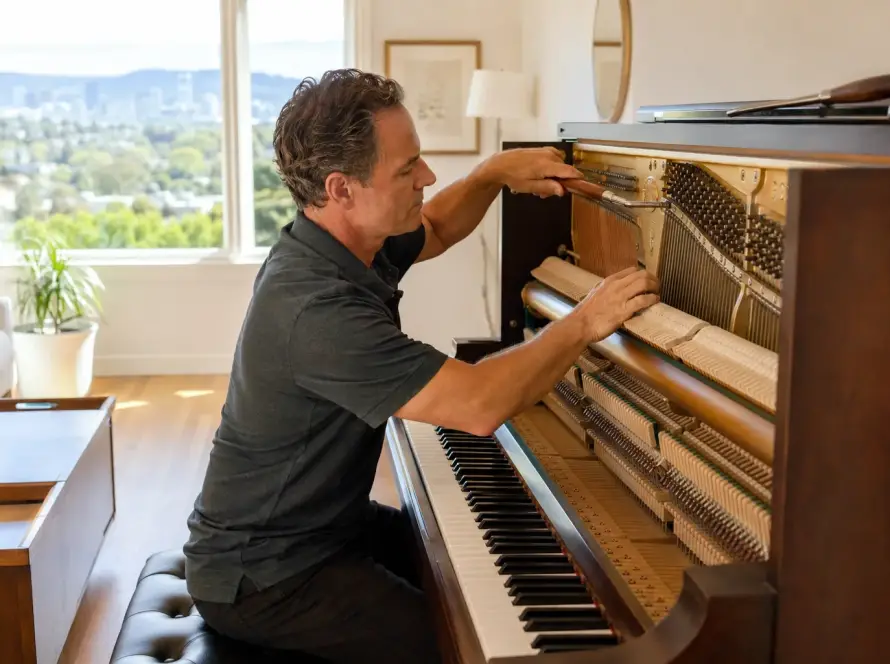
Before any work begins, a technician examines the piano from the inside out. The soundboard, bridges, pinblock, strings, tuning pins, action components, hammers, dampers, keys, and cabinet all get assessed. This inspection determines what needs to be repaired, what needs to be replaced, and what can be left alone.
The evaluation also determines whether restoration makes financial sense for that particular instrument. Not every piano is worth restoring. A well-made instrument from a reputable manufacturer almost always is. A mass-produced piano with a compromised soundboard may not be.
Structural Work
This is the foundation of the restoration. If the soundboard is cracked or the pinblock can no longer hold tuning pins at proper tension, those issues have to be addressed before anything else. Structural repairs affect everything downstream — tone, tuning stability, and longevity.
Restringing is also part of this stage for many older pianos. Strings corrode over time and lose their ability to hold pitch and produce a clean tone. New strings combined with new tuning pins reset the instrument’s ability to stay in tune.
Action Rebuilding and Regulation
The action is the mechanical system that connects your fingers to the strings. It includes the hammers, shanks, flanges, wippen assemblies, and hundreds of small felt and leather components that wear down with use and age.
Rebuilding the action means replacing worn parts and then regulating — adjusting every moving component to precise tolerances so that every key responds consistently. Regulation is painstaking work. On a grand piano there are thousands of individual adjustments. Done well, it transforms how the instrument plays.
Refinishing
Not every restoration includes refinishing the cabinet. Some owners prefer to preserve the original finish with cleaning and touch-up work. Others want the piano to look as good as it plays.
Our piano rebuilding and refinishing service covers stripping the old finish, addressing any wood damage, and applying new lacquer or polyester in multiple coats. Each coat needs to cure before the next is applied, which is part of why refinishing adds time to the project.
Voicing and Final Tuning
The last stage is voicing — adjusting the density of the hammer felt so the tone matches the owner’s preference and the piano’s character. A brighter sound, a warmer sound, more projection or more intimacy. Voicing is where the technical work becomes musical.
After voicing, the piano gets a full tuning. It will need another tuning several weeks later once it has settled into its environment, which is standard after any major work. You can read more about what piano tuning involves and when to schedule it.
Is Your Piano Worth Restoring?
This is the question that matters most, and there is no universal answer. A few factors point in one direction or the other.
Restoring usually makes sense when:
- The piano was made by a reputable manufacturer
- It has sentimental or historical value
- The soundboard is structurally sound
- You want a specific instrument, not just any piano
Replacement may make more sense when:
- The soundboard is severely cracked or warped
- The piano is a lower-quality mass-produced instrument
- You need an instrument quickly and cannot wait several months
A qualified technician can give you an honest answer during an evaluation. Be cautious of any shop that recommends full restoration before doing a thorough inspection. The scope of work should follow the condition of the instrument, not the other way around.
What to Look for in a Piano Restoration Specialist
Restoration is skilled craft work, and the quality of the result depends heavily on who does it. A few things worth confirming before you commit:
- Look for a Registered Piano Technician (RPT) credentialed through the Piano Technicians Guild
- Ask how many restorations they complete each year and what types of pianos they specialize in
- Request to see before and after examples of past work
- Get a written estimate that breaks down the scope of work
- Ask how they handle communication during the process — months can go by without updates if you do not set expectations upfront
At Sweet Sound Piano, we have been working on Bay Area instruments for over 30 years. Restoration and rebuilding are part of what we do alongside piano tuning, piano moving, and piano storage. If you have a piano you are not sure about, the right starting point is an evaluation. Contact us and we can tell you what the instrument needs and whether it makes sense to move forward.
One More Thing Worth Knowing
A piano that has just been restored still needs regular maintenance. Tuning is recommended at least twice a year under normal conditions, and more frequently in the first year after a restoration as the new strings stretch and settle.
The work put into restoration is an investment. Ongoing tuning and regulation protect that investment and keep the instrument performing at its best for years to come. If your piano needs tuning between now and a restoration, or if you need the instrument moved before work begins, Sweet Sound handles both — piano moving and piano storage for instruments waiting on restoration work.piano storage</a> for instruments waiting on restoration work.